A product analyst helps a product team make better decisions using data, customer insight, and clear measurement. If you like asking “what is happening inside the product, why is it happening, and what should we do next,” this is a strong career path in 2026.
What makes 2026 different is the toolset and expectations. Many companies now expect product analysts to be comfortable with event based data, experimentation, and product analytics platforms, not just spreadsheets. They also expect better communication, because the hardest part is rarely querying data. The hardest part is turning findings into choices a product team will actually act on.
This guide is written as a practical roadmap. You will learn what a product analyst does, what skills matter most, a step by step path to break in, and salary benchmarks across multiple regions using recent sources.
Product analyst meaning in 2026
A product analyst studies how people use a product, finds patterns in behavior, and translates those patterns into insights that improve the product. This includes measuring usage, tracking funnels, identifying drop offs, and explaining what changes could improve outcomes like activation, retention, and conversion. Coursera describes product analysts as people who watch how users interact with products and analyze the resulting data to infer preferences, needs, and behaviors.
A product analyst is not only a reporting role. The best product analysts help teams answer questions like:
- Which customer segment is gaining or leaving and why
- Which feature improves retention and which feature creates confusion
- Where does the user journey break down
- What experiment should we run next
- How should we define success for the next release
Product analyst role and responsibilities in 2026
Your responsibilities will change based on company size and maturity, but most product analyst roles include a core set of duties:
- Define and monitor product metrics like activation, retention, churn, feature adoption, and conversion
- Query data from product event tables and business systems to answer product questions
- Build dashboards and recurring reporting that teams trust
- Design and analyze experiments such as AB tests
- Combine quantitative data with qualitative feedback so insights are not purely numbers
- Communicate insights to product managers, designers, engineers, growth teams, and leadership
Many job descriptions also emphasize understanding consumer needs, comparing products to competitors, and supporting teams involved in product creation and marketing.
Product analyst day to day responsibilities in 2026
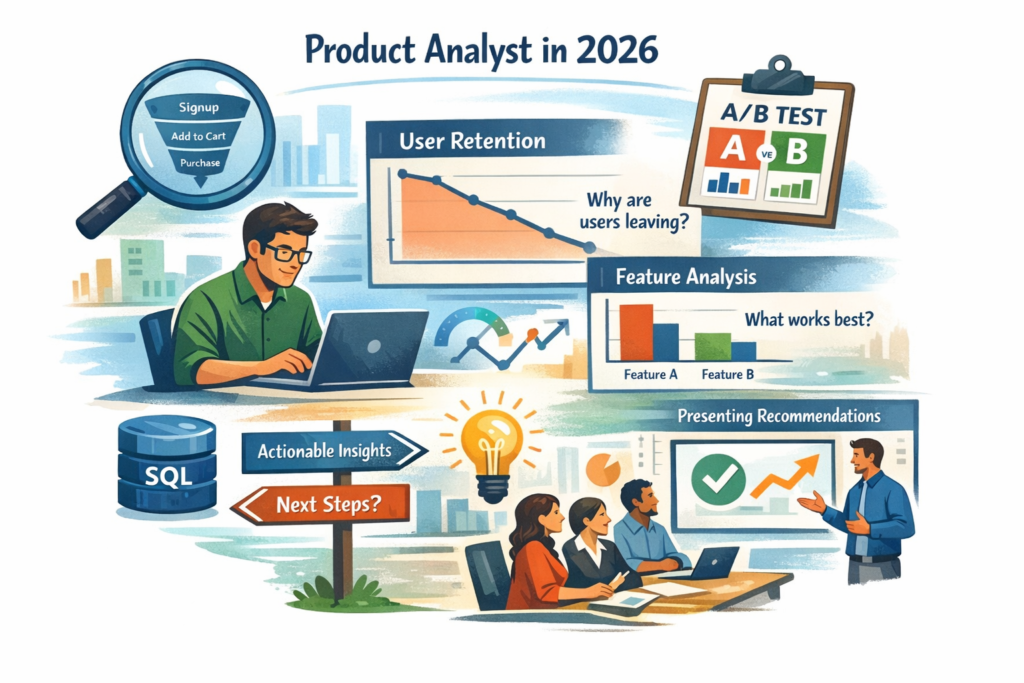
Day to day work depends on whether the product is in growth mode, redesign mode, or optimization mode. A realistic week often includes:
- Reviewing a dashboard for product health and investigating anomalies
- Writing SQL queries to answer questions raised in a standup or a planning meeting
- Running a funnel analysis to find where users drop out
- Doing cohort retention analysis to see if new users stick around longer than last month’s cohort
- Checking instrumentation, event naming, and tracking consistency
- Partnering with a product manager to define an experiment and success criteria
- Presenting findings in a short, decision friendly doc or slide
Many product analyst role breakdowns describe collecting, processing, and interpreting product usage data and feedback to identify pain points and opportunities.
Product analyst vs data analyst in 2026
A product analyst is a type of analyst, but the focus is narrower and deeper.
- A data analyst may work across finance, operations, marketing, and logistics
- A product analyst focuses primarily on the product experience and product outcomes
- Product analysts usually work with event data, user journeys, experiments, and feature adoption
- Product analysts are expected to understand product strategy tradeoffs and user behavior
In practice, many people move into product analyst roles after working as a data analyst or business analyst, then specializing. Product School notes that many product analysts start in roles like data analyst, business analyst, or product ops and then specialize.
Product analyst skills you need in 2026
If you want a clean step by step plan, start by understanding the skill buckets. A product analyst is hired for a mix of technical ability and product thinking.
Technical skills for product analyst in 2026
- SQL for querying product and business data
- Spreadsheets for fast analysis, sanity checks, and stakeholder friendly outputs
- Basic statistics for understanding variation, confidence, and experiments
- Data visualization for clear charts and dashboards
- Familiarity with product analytics tools such as Amplitude or Mixpanel
Product School specifically highlights SQL, Excel, product analytics platforms, AB testing, reporting, and basic visualization as common expectations.
Many skills lists also call out SQL as crucial for extracting and manipulating data for decision making.
Product thinking skills for product analyst in 2026
- Understanding funnels, activation, retention, churn, and lifecycle thinking
- Turning a vague question into a measurable hypothesis
- Knowing which metric matters for the decision at hand
- Connecting insights to a practical next step the team can execute
Communication skills for product analyst in 2026
- Writing clear narratives: what you found, why it matters, what to do next
- Stakeholder management: aligning on definitions and avoiding metric chaos
- Presenting tradeoffs and uncertainty honestly without freezing decisions
Product analyst tools stack in 2026
You do not need every tool to get hired, but you should know what a typical stack looks like.
- SQL plus a data warehouse or relational database
- Spreadsheets for quick analysis
- A BI tool like Tableau, Power BI, or Looker for dashboards
- A product analytics platform such as Amplitude or Mixpanel for event based analysis
- Experimentation tooling or feature flag tooling depending on the company
- A documentation space where analyses and decisions live so knowledge does not disappear
The most important concept is not the tool name. It is the workflow: reliable data in, clean definitions, repeatable analysis, and clear decision outputs.
Product analyst step 1 in 2026 understand what products are and how they win
Before you touch SQL, learn product fundamentals. Product analysts are judged on whether their work improves product outcomes, not whether the query is clever.
Do this first:
- Choose one product category you understand: ecommerce, fintech, SaaS, consumer apps, marketplaces, B2B tools
- Learn the user journey for that category: acquisition, onboarding, activation, retention, monetization
- Learn common product metrics and what they mean in that category
- Read product teardown style content so you build intuition about why products work
Output you should create in this step:
- A one page “product map” of a real app showing the key steps a user takes
- A list of the top 10 product questions you would want to answer with data
Product analyst step 2 in 2026 learn SQL for product data
SQL is the single most common hard requirement for product analyst roles. You do not need to be a data engineer, but you must be able to pull data accurately and efficiently.
Learn SQL in this order:
- SELECT, WHERE, GROUP BY, ORDER BY
- JOINs including inner, left, and full
- Aggregations including COUNT DISTINCT and conditional sums
- Date handling and time windows
- Window functions such as ROW NUMBER, LAG, LEAD, and rolling averages
- Common table expressions for readable multi step analysis
- Building funnel queries and retention cohorts
Practice using product style tables:
- events table with user id, event name, timestamp, properties
- users table with signup date, plan, region
- orders table if ecommerce, subscriptions table if SaaS
Portfolio ready SQL exercises:
- Build an activation funnel from signup to first key action
- Create a weekly retention cohort table
- Identify the top events that correlate with better retention
- Segment results by device, country, channel, or plan
If you can do those four exercises, you are already ahead of many applicants.
Product analyst step 3 in 2026 master spreadsheets and lightweight storytelling
Spreadsheets are still a core tool because stakeholders understand them. They also help you catch mistakes before you present results.
Skills to master:
- Pivot tables
- Lookup functions and basic joins inside a sheet
- Percent change, contribution analysis, and simple forecasting
- Charting that shows trends without noise
A good product analyst can take a messy dataset, clean it, and communicate a clear story in one page.
Product analyst step 4 in 2026 learn statistics and experimentation basics
You do not need an advanced statistics degree. You do need to understand enough statistics to avoid misleading conclusions.
Core topics:
- Mean, median, variance, and distribution intuition
- Confidence intervals and why point estimates are not enough
- Statistical significance vs practical significance
- Sample size basics and why underpowered tests mislead
- Experiment design basics: control vs variant, randomization, guardrail metrics
- Common AB test pitfalls: peeking, selection bias, multiple comparisons
A product analyst who can explain “what could be causing this result besides the feature change” is extremely valuable.
Product analyst step 5 in 2026 learn product metrics that companies actually use
Product metrics are your language. You need to know which metric fits which question.
Common product metrics:
- Activation rate: percent of new users who reach the first meaningful outcome
- Conversion rate: percent who move from one step to the next in a funnel
- Retention: percent who come back after day 1, day 7, day 30
- Churn: percent who stop using or cancel
- Feature adoption: percent of active users who use a feature within a time window
- DAU and MAU: daily active users and monthly active users
- Stickiness: DAU divided by MAU, used carefully as a directional signal
- LTV: lifetime value, especially for monetized products
Some role guides call out churn, conversion, feature adoption, DAU, and MAU as common monitored product metrics.
Your job is not to track every metric. Your job is to pick the few metrics that match the decision.
Product analyst step 6 in 2026 get comfortable with product analytics platforms
Many companies rely on a product analytics platform to explore user behavior quickly. Even if the role uses SQL heavily, you should be able to navigate these platforms.
What to learn:
- Event taxonomy and naming conventions
- Funnel reports and drop off analysis
- Cohort creation and cohort comparison
- Segmentation and breakdowns
- Paths analysis to see common sequences
- Dashboard creation with clear definitions
Product School explicitly mentions product analytics platforms such as Mixpanel or Amplitude as common tools for product analysts.
Product analyst step 7 in 2026 build a portfolio that proves product thinking
A product analyst portfolio is not about fancy visuals. It is about showing you can answer product questions end to end.
Build 4 to 6 projects, each with the same structure:
- The question
- Why it matters
- The data and definitions
- The analysis approach
- The findings
- The recommendation and expected impact
- Limits and what you would test next
Portfolio project ideas that map to real work:
- Onboarding funnel diagnosis for a real product
- Retention cohort analysis and segmentation with a clear recommendation
- Feature adoption analysis before and after a change
- Experiment analysis with guardrails and interpretation
- Pricing or packaging sensitivity analysis using public data assumptions
- Instrumentation audit: what events should be tracked to answer key questions
If you cannot access real product data, use public datasets and clearly state assumptions. Hiring managers are checking how you think, not whether you had privileged access.
Product analyst step 8 in 2026 get experience even before you land the title
Many people break in by doing product analysis work inside adjacent roles.
Common stepping stone roles:
- Data analyst
- Business analyst
- Product operations
- Growth analyst
- Marketing analytics if the company has strong digital funnels
Indeed’s career advice also emphasizes gaining practical experience through internships or related roles, and considering relevant certifications to stand out.
Other guides similarly outline steps like earning education, getting experience, and considering certificates.
Fast ways to build experience:
- Volunteer analytics for a startup, nonprofit, or small business with a real website
- Offer to build a dashboard for a product manager you know
- Take ownership of product KPI reporting in your current role
- Run a small experiment analysis project if your team ships changes regularly
Product analyst step 9 in 2026 write a resume that reads like outcomes not tasks
A weak resume lists tasks: “built dashboards, did reporting.”
A strong resume lists outcomes and decisions supported:
- “Identified onboarding drop off and recommended changes that improved activation by X percent”
- “Built retention cohorts and segmentation that informed roadmap priorities”
- “Designed experiment measurement and analyzed results leading to launch decision”
Even if you do not have a perfect metric impact number, you can still show decision impact:
- What decision did your analysis enable
- How did it reduce uncertainty
- What did the team do differently because of it
Product analyst step 10 in 2026 prepare for product analyst interviews
Product analyst interviews typically test four areas:
- SQL and data manipulation
- Product metrics and decision framing
- Experimentation and statistical reasoning
- Communication and stakeholder thinking
How to practice:
- Do timed SQL exercises using realistic event tables
- Practice explaining a funnel and what you would investigate next
- Practice an AB test debrief: what happened, what you trust, what you do next
- Practice writing a one page analysis summary with recommendation
A common interview pattern is a case question like: “Retention dropped last week, what do you do?” Your answer should show structure:
- Confirm the metric definition and measurement window
- Segment by cohort, channel, geography, device, plan
- Check product changes, tracking changes, and external factors
- Identify leading indicators that changed first
- Propose hypotheses and tests
Product analyst salary in 2026 in the United States
Salary depends heavily on location, industry, seniority, and company type. The most reliable approach is to use recent aggregated benchmarks and then adjust based on your situation.
Recent US benchmarks:
- Indeed reports an average product analyst salary of $98,303 per year in the United States, with a wide range that includes lower and higher ends, updated January 26, 2026.
- Indeed reports an average senior product analyst salary of $115,137 per year in the United States, updated January 25, 2026.
- In New York, NY, Indeed reports an average product analyst salary of $119,664 per year, updated January 25, 2026.
- Glassdoor’s US view also breaks out top paying industries and shows median total pay around the low six figures in several sectors.
How to think about your likely range in the US:
- Entry level at smaller companies will often be closer to the lower end of reported ranges
- Roles that require strong experimentation, deep SQL, and ownership of KPI design trend higher
- Large tech and high growth companies often pay more, especially when equity is included
Product analyst salary in 2026 in India
India salary benchmarks vary widely based on city, company type, and whether the data source tracks base pay or total compensation.
Recent India benchmarks from multiple sources:
- Glassdoor shows an India typical pay range roughly ₹7,47,500 to ₹17,00,000 annually for product analyst roles and reports an average around ₹11,00,000 as of February 2026 based on thousands of submissions.
- Indeed India reports an average product analyst salary of ₹16,47,269 per year, updated November 11, 2025.
- Payscale reports an average base salary around ₹815,756 per year with ranges, last updated late 2025.
- For Bengaluru, Glassdoor shows a trajectory and common banding such as roughly ₹7L to ₹17L for product analyst, with higher bands for senior and lead roles.
Why these numbers do not match perfectly:
- Different sources capture different mixes of companies
- Some sources focus on base pay while others mix base and additional pay
- Sample sizes and reporting recency differ by location and job title variants
Practical advice for India salary expectations:
- Anchor on your city first, then your industry, then your seniority
- If the role requires experimentation ownership, strong SQL, and cross functional influence, negotiate toward the top of the local band
- Bring proof: portfolio, case studies, and clear examples of decision impact
Product analyst salary in 2026 in the United Kingdom
UK benchmarks:
- Indeed UK reports an average product analyst salary of £53,345 per year, updated January 25, 2026.
- Glassdoor UK reports an average around £48,838 with typical pay ranges and additional context as of February 2026.
London often pays higher than many other regions, and finance and tech roles can shift the band upward.
Product analyst salary in 2026 in Canada
Canada benchmarks:
- Indeed Canada reports an average product analyst salary around $79,056 per year, updated January 2026.
- Glassdoor Canada reports an average around $70,001 with typical pay ranges as of February 2026.
Product analyst salary in 2026 in Australia
Australia benchmarks:
- Indeed Australia reports an average product analyst salary of $94,389 per year, updated mid January 2026.
- SEEK shows a commonly advertised range around $100,000 to $120,000 for product analyst roles in Australia.
Product analyst career path in 2026
A common progression looks like this:
- Junior product analyst or product analytics associate
- Product analyst owning a product area or funnel
- Senior product analyst owning experimentation, segmentation, and strategy support
- Lead product analyst or principal analyst guiding standards across teams
- Analytics manager or head of product analytics
Exit opportunities and adjacent moves:
- Product management, especially growth or experimentation focused PM paths
- Data science roles if you deepen modeling skills
- Product operations leadership if you love process and alignment
- Growth roles if you focus on acquisition and activation systems
Product School’s career guide also points out that many successful product analysts come from data analyst, business analyst, or product ops paths before specializing.
Product analyst first 90 days plan in 2026
If you land your first product analyst role, your early impact comes from trust and clarity.
Days 1 to 30 for product analyst in 2026
- Learn the product, user journeys, and business model
- Audit definitions of core metrics and align on one source of truth
- Identify the highest value recurring questions and build reliable reporting
- Validate tracking quality and flag missing events
Days 31 to 60 for product analyst in 2026
- Deliver one deep dive analysis that answers a meaningful product question
- Partner on one experiment design including guardrails and success metrics
- Create a simple insights cadence so stakeholders know when to expect updates
Days 61 to 90 for product analyst in 2026
- Build a prioritized opportunity list based on evidence
- Improve instrumentation or metric definitions to reduce future confusion
- Establish a reusable analysis template so your work scales
Product analyst mistakes to avoid in 2026
- Reporting numbers without defining them clearly
- Chasing correlation and presenting it as causation
- Over focusing on dashboards and under focusing on decisions
- Ignoring tracking quality and assuming the data is right
- Presenting insights without a recommendation or next step
- Communicating uncertainty poorly, either overstating confidence or hedging so much no one acts
Product analyst checklist in 2026
If you want a simple checklist to follow, use this:
- Learn product basics and one domain deeply
- Become job ready in SQL, especially joins, window functions, funnels, cohorts
- Learn core product metrics and how to pick the right one for a decision
- Learn experimentation basics and how to interpret results responsibly
- Build 4 to 6 portfolio projects with clear recommendations
- Get experience via adjacent roles, internships, or internal projects
- Prepare for SQL plus product case interviews
- Anchor salary expectations using recent benchmarks and your location
Product analyst conclusion in 2026
Becoming a product analyst in 2026 is realistic if you focus on the right sequence: product fundamentals, SQL, metrics, experimentation, then communication. The job is not about being the best at dashboards. It is about being the person who can take messy behavior data and turn it into clarity that drives product decisions.
Frequently Asked Questions About Becoming a Product Analyst in 2026
What does a product analyst do in 2026?
A product analyst helps product teams make better decisions using data. In 2026, this includes analyzing user behavior, tracking funnels, identifying drop-offs, running experiments, and turning insights into actions that improve activation, retention, and conversion.
Is product analyst a good career in 2026?
Yes. Product analyst roles are in high demand because companies rely heavily on data-driven product decisions. Analysts who understand product metrics, experimentation, and communication are especially valuable.
What skills do you need to become a product analyst in 2026?
You need SQL, spreadsheets, basic statistics, data visualization, familiarity with product analytics tools like Amplitude or Mixpanel, strong product thinking, and the ability to communicate insights clearly.
How do I become a product analyst step by step?
Start by learning product fundamentals, then master SQL and spreadsheets, understand product metrics, learn experimentation basics, get comfortable with product analytics platforms, build a strong portfolio, gain experience through adjacent roles, and prepare for SQL and product case interviews.
What tools do product analysts use?
Common tools include SQL databases, spreadsheets, BI tools like Tableau or Power BI, product analytics platforms such as Amplitude or Mixpanel, experimentation tools, and documentation tools for sharing insights.
What is the difference between a product analyst and a data analyst?
A data analyst works across multiple business areas, while a product analyst focuses specifically on product usage, funnels, experiments, and product outcomes. Product analysts are expected to understand product strategy and user behavior deeply.
What is the salary of a product analyst in 2026?
In the US, average salaries range from around $98,000 to $115,000 per year. In India, salaries commonly range from ₹7.5L to ₹17L annually, depending on location, company, and experience.
Do I need a data science degree to become a product analyst?
No. A degree is less important than practical skills like SQL, product metrics, experimentation knowledge, and the ability to drive product decisions using data.
How long does it take to become a product analyst?
Most people can become job-ready in 6 to 12 months with focused learning, hands-on practice, and a solid portfolio.
